
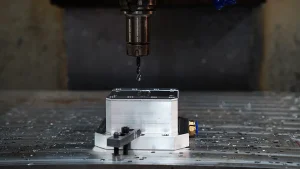
With precise CNC machining, aluminum alloys can be turned into high-performance parts for businesses that need them. Engineers and procurement teams need to understand how alloy chemistry, cutting strategy, and cost drivers all affect each other. This guide breaks down the technical choices, from the flexibility of 6061 to the strength of 7075 aerospace, giving you information you can use on your next project.
Why Aluminum Works Well for CNC Machining
High Machinability and Faster Production Cycles
Aluminum cuts easily and doesn’t wear down tools too quickly, so spinning speeds of 15,000 RPM or more are possible. Compared to steel, cycle times are much shorter, which means lower machine-hour costs and faster delivery for your production plan.
Excellent Strength-to-Weight Ratio
Parts made from aluminum perform like steel at one-third the weight. This property makes aluminum indispensable for aerospace, automotive, and any application where every gram matters to fuel efficiency or handling dynamics.
Corrosion Resistance and Surface Treatment Compatibility
Aluminum is protected from normal wear and tear by layers of natural oxides. Anodizing, chromating, and powder coating all work very well on metal substrates that have been properly prepared when you need harder surfaces or certain colors.
Thermal and Electrical Conductivity Advantages
Aluminum gets rid of heat faster than most other metals, which makes it perfect for holding electronics and LED lights. Because it conducts electricity well, it can also be used for battery terminals and bus bars in stations for electric vehicles.
Suitability for Prototypes and Production Parts
The same CNC setup can make 5,000 production units or five study parts without having to change the way the tools are used. Form and fit are checked with prototypes, and then the final scales are made using the same fixtures and tried-and-true feeds.
Aluminum Alloy Selection for CNC: What Actually Matters
The choice of material affects not only performance but also the cost and time of production. Specialized alloys are needed for some aerospace or electronics uses, even though the 6xxx series is used everywhere. It is important for you to strike a balance between technical needs and product manufacturing costs. The table below shows how well common aerospace and industrial alloys that precise machine shops sell work.
6061 vs 7075 vs 2024 — Performance Tradeoffs
| Alloy | UTS (MPa) | Machinability Rating | Typical Application Tier | Relative Cost |
| 6061-T6 | 310 | Excellent (90%) | General industrial, automotive enclosures, fittings | Baseline |
| 7075-T6 | 572 | Good (70%) | Aerospace structural, high-stress bicycle/EV components | ~2.5x 6061 |
| 2024-T3 | 469 | Fair (60%) | Aircraft wing spars, fuselage frames (poor corrosion resistance) | ~2.0x 6061 |
| 5052-H32 | 228 | Very Good (85%) | Marine, fuel tanks, electronics enclosures (excellent formability) | ~1.3x 6061 |
| 6082-T6 | 310 | Excellent (90%) | Heavy-duty structural, bridges, cranes (European alternative to 6061) | ~1.1x 6061 |
Series-Level Properties Engineers Should Know
2xxx (Al-Cu)
Al-Cu is similar to mild steel in terms of strength and resistance to wear. Unfortunately, 2024 doesn’t fight corrosion well, and it usually needs to be clad or treated with Alodine. Do not use if welding is needed.
5xxx (Al-Mg)
Al-Mg has exceptional resistance to corrosion, especially in marine settings. If you want to bend sheet metal and put together soldered parts, then 5052 is the ideal choice. You cannot heat the Al-Mg.
6xxx (Al-Mg-Si)
If you want to make good chips, then you must consider 6061 and 6082 because both are strong metals that work well when CNC cutting and react well to anodizing. It is perfect for testing and making a lot of things.
7xxx (Al-Zn)
The AL-Zn is an aluminum alloy with the best strength-to-weight ratio. 7075 is widely used in aerospace and the military. But it cracks easily from stress corrosion and shouldn’t be used for fusion welding.
Key Design Tips for CNC Machined Aluminum Parts
Maintain Appropriate Wall Thickness
The cutting process results in poor surface finishes and scrapped parts due to thin walls vibrating during the cut. For reliable machining, use walls above 1.5 mm thick for unsupported walls, and restrict height-to-thickness ratios to 8:1.
Maximize Internal Corner Radii
For this reason, you can use a 12 mm end mill to remove material quickly while using the 6 mm radius. A 1mm cutter radius makes the small and delicate cutter make dozens of slow passes around the same pocket.
Design Threads for Manufacturability
Roll-form taps form a tighter thread than standard taps without chips that could jam coolant systems. Use M4, M6 and M8 coarse threads as much as possible to achieve maximum cycle times.
Avoid Excessive Deep Cavities
Tools longer than 4 times the diameter must be used with special long-reach end mills that are more prone to chattering. If possible, break down deep features into individual features and/or redesign as through-holes.
Reduce Setup Complexity
Those components that require 3 or more vise rotations will add hours of operator time and cause misalignment errors. To design parts that can be machined in 2 setups or fewer, ideally 1 setup.
Balance Tolerance Requirements with Cost
A change in tolerance from ±0.05 mm to ±0.01 mm results in a doubling or tripling of machining cost, due to the reduction in the speed at which feeds can be used, and because every part must be inspected after it has been produced. Tighten tolerances only as necessary for assembly.
Consider Post-Processing During Design
The thickness of the anodized surfaces varies from 2 to 50 microns, depending on the type. For threads, press-fit bores and mating faces, pre-plate allowances must be determined prior to machining.
CNC Processes Used for Aluminum and Their Technical Parameters
Your selection of the right process impacts lead time and quality.
Milling — Toolpath Strategy and Cutting Parameters
Most flat parts are made with high-speed 3-axis grinding. Today’s CAM software uses trochoidal toolpaths to keep the chip load constant, even in deep pockets. When working with 6061, a ½” carbide end mill should have a chip load of 0.005” per tooth, 10,000+ RPM, and 12–15% radial contact. With our 5-axis CNC machining, we don’t have to do multiple sets for shapes like pump impellers that aren’t simple.
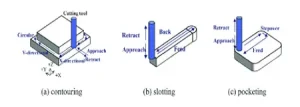
Turning and Multi-Axis Considerations
Aluminum that has been hard-turned can have a surface finish of Ra 0.4 µm for cylinder-shaped parts without having to be ground. Multitasking tools (mill-turn) make aerospace fittings all at once, so there are no mistakes in the centering.
Tolerances and Surface Finish Achievable
Linear limits of ±0.05 mm are normal, and tight-tolerance finishing holds ±0.01 mm. As-machined ends have an average Ra of 1.6 µm. This can be lowered to Ra 0.4 µm by bead blasting or grinding. This is then used to seal surfaces. Check out our standard procedures for quality assurance.
Industry Applications by Sector
Aerospace and Defense
Primary alloys are 2024 and 7075. Structural ribs, motor housings, and optical mounts are just a few of the uses for these parts. To stop stress corrosion breaking, you have to use stress-relieving and post-machining anodizing (usually sulfuric acid).
Semiconductor and Electronics Manufacturing
Aluminum is the standard for wafer chuck tables, metrology frames, and thermal management plates. 5083 and 6061 are favored for their low particle generation and ability to be nickel-plated.
Automotive and EV Platforms
High-speed cutting of 6061 and 6082 makes it possible to make steering shafts, battery module housings, and cooling channels that are built right in. Lightweight materials are still important for extending the range of electric vehicles. This is something that current machine shops do very well.
Medical and Instrumentation
6061 is widely used for diagnostic imaging components and surgical device handles due to its excellent anodizing dye absorption for color-coding. Get a quote for custom medical parts.
Aluminum CNC Machining Cost: Real Drivers and Benchmark Ranges
Procurement managers must separate material overhead from non-recurring engineering (NRE).
Cost Structure Breakdown
| Cost Component | Typical Range (USD) | Key Variable |
| Setup/programming | $150 – $400 per job | Sure, this encompasses part complexity and the number of tool changes. |
| Machine time (3-axis) | $80 – $120 / hr | Feed rates, chip evacuation |
| Machine time (5-axis) | $150 – $250 / hr | Simultaneous motion, post-processing |
| Raw material (6061 billet) | $6 – $12 / lb | Plate or Bar Stock, quantity is a key consideration. |
| Raw material (7075 billet) | $15 – $25 / lb | Aerospace certs (AMS) + 20%. |
| Anodize Type II (clear) | $25 – $60 per batch | Rack density, part size |
| Hard-coat (Type III) | $80 – $150 per batch | Thickness (0.002” vs 0.004”) |
Geometric and Tolerance Factors
The price difference between a clamp that is ±0.1 mm and a spindle that is ±0.01 mm is exponential. The Machinery’s Handbook confirms that changing tolerances from ±0.05 mm to ±0.01 mm can make precise machining 2x to 3x more expensive because feeds have to be slower and inspections have to be done after the work is done.
Volume and Amortization Effect
Fixturing and code costs (NRE) are spread out over the batch. NRE can be 40% of the unit cost for 10 units, but it drops below 2% for 500 units. Repeatability scripts for robotic filling also lower the cost of labor that isn’t used for cutting.
DFM Levers That Reduce Cost
- Maximize internal corner radii:A 6 mm radius uses a 12 mm cutter, clearing a pocket in one pass. A 1 mm radius requires a fragile 2 mm cutter, increasing time and tooling cost.
- Avoid unnecessary tolerance stack-ups:Only critical interfaces need GD&T. Unilateral tolerances on non-functional surfaces waste machine time.
- Standardize thread sizes:Stick to common coarse threads (M4, M6) to utilize roll-form taps that eliminate chip disposal issues and run faster.
- Consolidate setups:Design parts to be machinable in a single vise setup if possible.
- Material substitution review:If 7075 isn’t strictly required for static loading, switching to 6061 dramatically increases spindle speed and tool life.
Aluminum vs. Other Materials — Cost and Cycle Time Comparison
| Material | Relative Machining Time | Relative Material Cost | Typical Use Case |
| Aluminum 6061 | 1.0x | 1.0x | Enclosures, brackets, heat sinks |
| Aluminum 7075 | 1.5x | 2.5x | Aerospace, high-stress structural |
| Stainless 304 | 3.0x – 4.0x | 1.8x | The material is used for medical, food contact, corrosion resistant parts. |
| Titanium Ti-6Al-4V | 6.0x – 8.0x | 12x – 15x | The possibility of implants, space hardware, and high-temperature applications is all highlighted. |
| Mild Steel 1020 | 1.8x | 0.4x | Structural mounts (non-corrosive) |
Conclusion
CNC machining of aluminum is the backbone of modern production. It makes it possible for designs to work in the real world. To be successful, you need to use the right metal for the job and make sure the part works best with the machine. For technical guidance on starting your project, visit our CNC machining center. Contact us today and get your personalized quotations and information.
FAQs
Is aluminum difficult to machine compared to other metals?
No, aluminum is considered one of the most machinable materials. Alloys like 6061 allow for extremely high cutting speeds (up to 3x faster than steel) and produce excellent surface finishes with minimal tool wear.
Can CNC-machined aluminum parts be welded after machining?
It depends on the alloy. 5xxx and 6xxx series (like 5052 and 6061) are highly weldable, though 6061 typically requires post-weld heat treatment to restore T6 temper. 7xxx series (7075) is prone to hot cracking and is generally not recommended for fusion welding.
What is the minimum wall thickness achievable in CNC-machined aluminum?
A general rule is 0.5 mm for short unsupported walls, but 1.5 mm to 2.0 mm is safer for structural loads. Wall height-to-thickness ratios should stay under 8:1 to avoid vibration and deflection.
Does anodizing affect dimensional tolerances on CNC-machined aluminum parts?
Yes. Type II anodizing creates a 2–5 µm growth on the surface (half penetration, half build-up). For precision bores, you must specify a pre-plate dimensional allowance to compensate. Hardcoat (Type III) can build up 25–50 µm.