
CNC machining pricing follows a relatively fixed cost model. By combining factors such as material, machine time, engineering programming, setup and machine preparation, tolerance requirements, inspection, surface finishing, delivery risk, and management overhead, a reasonable price can be determined. Below, this is explained clearly by breaking the quote down by its components.
A Commonly Used Quoting Framework
In most CNC orders, factories internally calculate costs using logic similar to the following:
One-time costs (more like “startup costs”):
Engineering review, process planning, programming, fixturing strategy, and first-article approval.
Per-part costs (which become more stable as production continues):
Machining cycle time, material consumption, tool wear or replacement, sampling inspection, surface finishing, and packaging.
In one sentence:
Total price ≈ Material + One-time costs + (Machining time × machine hour rate) + Post-processing + Inspection + Management cost
The machine hour rate can be understood as the manufacturing cost required to keep a machine running for one hour. This includes depreciation, energy consumption, maintenance, facility costs, and management expenses, allocated across effective working hours. This concept is commonly explained in cost accounting discussions such as Calculating the Machine Hour Rate by Finance Strategists.
Material: Not Just the Unit Price
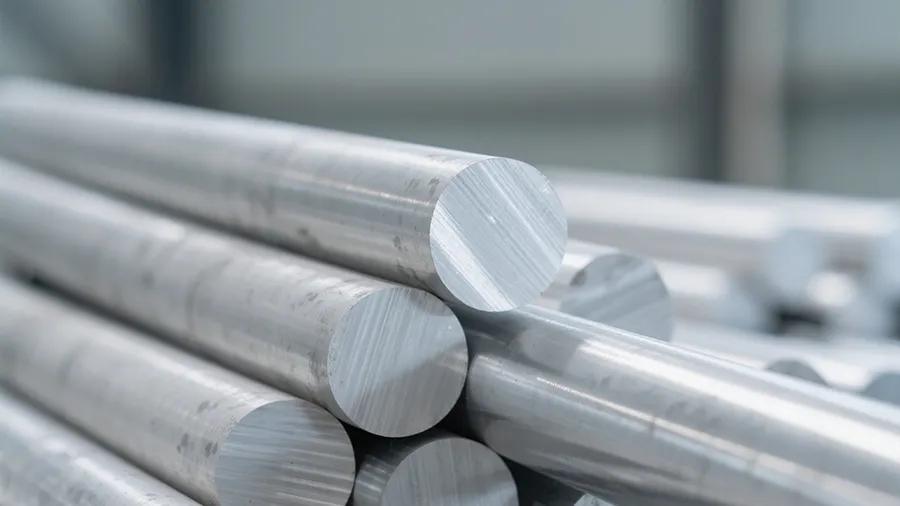
Material influences pricing at multiple levels.
First is the raw material price itself, which depends on alloy grade, sourcing channels, and market fluctuations.
Second is material utilization—whether the selected stock size results in excessive waste.
Third is machinability. Material hardness and toughness affect tool wear, machining speed, and yield risk, which in turn influence machining time and tooling consumption.
Even for the same category of material, such as stainless steel, different grades can have a significant impact on tool life and cycle time. These effects are usually reflected in machining time and tooling cost rather than material price alone.
Why Machining Time Is Often the Core Factor Behind Price Differences
Many customers intuitively focus on material cost, but for complex parts, machine occupation time is often the largest variable.
For example, two aluminum parts may use the same material, but differences in structure can result in machining times that differ by several multiples, naturally leading to large differences in quoted price.
Machining time is not just the time when the tool is cutting. From an engineering perspective, it is commonly broken down into:
- Machine setup and preparation: clearing the previous job, loading tools, installing fixtures, probing, and alignment.
- Fixturing and re-clamping: clamping, flipping the part, secondary positioning, and multiple setups.

- Material removal: the actual cutting and toolpath execution.
This stage-based way of breaking down manufacturing time is commonly used in engineering practice and is frequently referenced in manufacturing time estimation materials, including those from the Massachusetts Institute of Technology.
From a quoting perspective, this means that for prototypes and small batches, one-time time costs account for a large proportion of the unit price. As quantities increase, these costs are spread across more parts, and unit prices decrease significantly.
Engineering and Programming Costs: Why Small Batches Are Sensitive
When you submit a new part, the factory typically needs to complete the following work:
- Manufacturability evaluation (whether the part can be machined and where the risks are)
- Process planning (roughing versus finishing, turning versus milling, number of setups)
- CAM programming and generation of CNC programs (commonly referred to as G-code, based on standardized numerical control data formats defined in ISO 6983)
- First-article trial cutting and adjustment
These tasks do not differ much between producing one part and producing fifty parts, but the difference in cost allocation is significant. This is one of the most common reasons customers feel that CNC quotes for small quantities are unexpectedly high.
Tolerances and Drawing Requirements
What you specify on the drawing directly translates into manufacturing cost.
If tolerances are not specified for every dimension, manufacturers commonly apply a general tolerance system to simplify dimensioning and acceptance. In practice, many factories rely on general tolerances such as those defined in ISO 2768 to establish acceptable variation when explicit tolerances are not provided.
When functional requirements become more complex—such as positional accuracy, concentricity, or form relationships—geometric tolerancing is used. In many international and cross-border supply chains, ASME Y14.5 is widely regarded as the authoritative design language for defining and interpreting GD&T on engineering drawings.
From a pricing perspective, tighter requirements usually result in slower finishing strategies, more stable fixturing, stricter process control, and higher inspection costs.
Inspection and Quality

As tolerance, geometric, and consistency requirements increase, inspection often moves beyond basic tools such as calipers or micrometers and shifts toward more systematic measurement methods, such as coordinate measuring machines.
At the standards level, the acceptance and verification of such measurement systems are described in the ISO 10360 series, which is commonly referenced when defining inspection capability and cost.
For quoting purposes, this typically means increased inspection time, especially for first articles and critical dimensions, as well as the possible requirement to provide inspection reports.
Surface Roughness and Surface Texture
Customers often request a “smooth surface,” but from an engineering perspective, surface roughness needs to be defined using measurable parameters. The most commonly used parameter is Ra, whose definition and interpretation are widely referenced in surface metrology materials such as those provided by Keyence.
Many drawings also use roughness grades to express acceptable surface ranges. Practical explanations of these grades and their relationship to Ra values are commonly summarized in manufacturing references such as Xometry Pro.
Lower roughness requirements generally mean finer toolpaths, slower feed rates, higher tooling requirements, and more stable processes. In some cases, additional operations such as polishing, grinding, or blasting may be required.
Surface Treatment and Secondary Processes
Many CNC parts require surface treatment after machining.
For example, anodizing is commonly used for aluminum parts to improve corrosion resistance and appearance. The general requirements for decorative and protective anodic coatings are described in references such as ISO 7599.
Hard anodizing, which focuses more on wear resistance, follows different process requirements and is discussed in standards such as ISO 10074.
In quotations, surface treatments are usually listed as separate cost items. They may be performed in-house or outsourced, which can introduce additional logistics and scheduling variability.
Quantity and Lead Time
For the same part, CNC pricing almost always follows a pattern where higher quantities result in lower unit prices.
When quantities are low, one-time engineering and setup costs account for a large share of the unit price. As quantities increase, these costs are spread across more parts, and unit prices decrease. However, higher volumes may introduce new cost factors, such as fixture optimization or batch inspection planning.
If expedited delivery is required, the higher scheduling priority and increased risk are typically reflected in the quoted price.
What Information Helps You Get Faster and More Accurate Quotes?
To reduce back-and-forth communication and receive quotes closer to final execution cost, it is recommended to provide the following information upfront:
- 3D files, preferably in STEP format, which aligns with the product data exchange framework described in the ISO 10303 series
- 2D drawings clearly defining key dimensions and tolerance requirements
- Material grade, quantity, and required delivery time
- Surface roughness and surface treatment requirements
- Threading, press-fit, or assembly requirements
- Inspection expectations, such as sampling, full inspection, or measurement reports
One-Sentence Summary
The essence of CNC machining pricing is time and risk.
Material cost is visible, but machining time, number of setups, precision requirements, inspection depth, and delivery pressure are the factors that ultimately determine the final price.
Using an Automated Quoting System
If you want to minimize the time spent on back-and-forth communication and manual quotation, you can use an automated quoting system to obtain reference pricing and lead times within minutes.
For example, JCRapid provides an online quoting platform at https://app.jcrapid.com/. The system allows users to submit requirements directly and quickly receive pricing references. The platform also clearly emphasizes the protection of intellectual property and supports signing non-disclosure agreements.